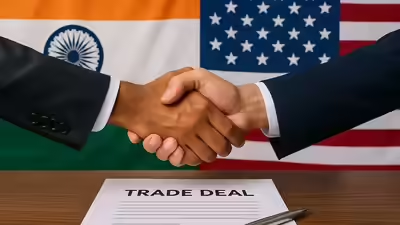
For quite some time, negotiators from both the US and India have maintained that the bilateral trade agreement between the two nations is nearing finalization. Yet, it appears that an impasse persists regarding this matter. The US Trade Representative (USTR), who had been in India for several days to finalize the agreement, returned to the US this week empty handed. This development has become a topic of discussion in the media. It is worth noting that India and the US had previously signed a framework for the trade agreement in February. Following the signing of that framework, statements from the US administration created significant confusion, as it contradicted India's stated position. Opposition parties and a section of the media capitalized on this situation to put the government in the dock. A primary point of contention was the US side's repeated claim that India had promised not to purchase oil from Russia-an issue, not even mentioned in the framework. Furthermore, the US side claimed India had committed to purchasing goods and services worth $500 billion from the US over the next five years, whereas the framework had merely expressed an intention to make such purchases. Additionally, the US side raised issues regarding agricultural imports that went beyond the scope of the framework. Naturally, while it was not always appropriate for the Indian government to refute every claim, even when it was false-given diplomatic sensitivities-it did reiterate its stance from time to time. Nevertheless, these issues led to unwarranted criticism if the government in the Indian media, with allegations that the government was capitulating to the US at the expense of national interest.
Barely less than two weeks, after the signing of framework of bilateral trade agreement between India and the US, the US Supreme Court declared the arbitrary tariffs (reciprocal tariff) imposed by President Trump unconstitutional. Consequently, trade experts believe that, in light of the Supreme Court's decision, the consensus reached on the trade framework between the two nations has lost its significance. When the interim framework for a trade agreement was signed in February, the US had imposed high 'reciprocal tariffs' on imports from several countries. Under the framework, the tariff burden on India was expected to drop to around 18 percent, whereas many competing nations would have faced relatively higher tariffs. This would have granted Indian exporters a significant competitive advantage in the US market. Therefore, renegotiation has become essential. This argument carries considerable weight. It raises a question for India: how can one rely on benefits that the US can no longer guarantee? From India's perspective, the proposed trade agreement now appears more like a one-sided market-access arrangement rather than a balanced trade deal. This is why Commerce Minister, Piyush Goyal, maintains that while the India-US trade agreement is nearly ready, it cannot be signed unless India secures a competitive advantage over other nations.
As a result, the economic rationale behind the February framework has fundamentally shifted. The assumptions upon which the framework was built no longer hold true. Therefore, unless the terms are renegotiated to reflect the changed circumstances, the previous interim framework can be considered largely obsolete, as it fails to deliver the expected special benefits to India. Despite the framework agreement of February 2026, several issues remained unresolved. These include access to agricultural markets, dairy imports, tariff reductions on automobiles and industrial goods, digital trade and data governance, intellectual property concerns, 'rules of origin,' and issues regarding the movement of professionals and visas. Notably, the US seeks tariff reductions from India on automobiles, agricultural products, dairy items, medical devices, and alcohol. India remains firm against lowering these tariffs for two reasons: the livelihoods of people in the agriculture and dairy sectors, and strategic industrial development. Regarding dairy, a specific issue involves the practice of feeding animal-derived feed to livestock-often referred to as 'non-vegetarian milk'-which India cannot accept due to cultural and religious reasons.
Digital trade and data-related regulations are also significant stumbling blocks in the agreement. India views data as a strategic resource and is unwilling to compromise its future policy-making sovereignty, whereas the US opposes data localization efforts, and advocates for the free cross-border flow of data. It is worth considering whether India-poised to become a future digital superpower-can agree to such terms. The US seeks stronger patent protections to benefit its pharmaceutical and technology industries, while India aims to ensure the continued availability of affordable medicines and maintain flexibility within patent laws to foster the growth of its own technology sector.
Furthermore, the US administration has been consistently tightening its visa and immigration laws, sparking significant resentment not only within the Indian government but also among the general public. Yet, the draft trade agreement made no mention whatsoever of these issues. The US President and administration have frequently made statements regarding the imposition of sanctions on India for purchasing Russian oil, as well as granting permission for such purchases; this creates the impression that the decision to buy oil from Russia hinges on the US's discretion. However, the reality is quite different. In fact, oil purchases from Russia so far in 2026 have significantly exceeded those during the same period in 2025; specifically, in June, India is expected to import 2.55 million tonnes of oil daily from Russia-a figure that not only sets a record but also accounts for nearly half of India's total oil imports. While India has been reaping substantial economic benefits from these purchases, the US's stance on the matter is simultaneously becoming a hurdle in trade agreements between the two nations.