The label jugâdu shows that India is not just making do with less but it is doing more with intent. — Annu Kumari
Jugadu word carries multiple meanings depending on who uses it. To some, it implies clever improvisation; to others, a workaround culture born of scarcity. Indians have long been described as jugadu. Often, it is used patronisingly, as if innovation in India were accidental rather than deliberate. Yet India’s achievements in space and defence over the last decade demand a reassessment of this label. What they reveal is not makeshift ingenuity but systematic excellence under constraint.
With one of the lowest R&D expenditures as a share of GDP among major economies, today, India stands among a small group of nations capable of lunar landings, interplanetary missions, advanced missile technologies and complex strategic systems. What makes this extraordinary is not just what India has achieved, but how it has achieved it. This is a paradox. As world-class outcomes from limited resources communicates us something profound about India’s latent capabilities and the vast underutilised reservoir of talent that defines the country.
The Numbers That Don’t Tell the Whole Story
Through conventional metrics, India should not be where it is. Gross Expenditure on Research and Development (GERD) has hovered between 0.6% and 0.7% of GDP for years which is far below the global average and dramatically lower than countries like South Korea, the United States and China. Even as absolute R&D spending has increased, it has not kept pace with GDP growth. Moreover, India’s private sector contributes only around 36% of total R&D, whereas in advanced economies private industry accounts for more than 70%. On paper, this is the profile of a country that should struggle to innovate yet India has repeatedly defied these expectations. To explain this paradox, the narrative hovers around clichés about frugality or cost-effectiveness. But the reality is deeper. India’s success is not about spending less; it is about organising knowledge, talent, and purpose more effectively than the numbers suggest.
Jugad as Discipline, Not Disorder
The popular caricature of jugâd suggests shortcuts and temporary fixes. In India’s space and defence programmes, however, jugâd has taken on a very different meaning. It represents constraint-driven optimisation. In these sectors, India has never had the luxury of unlimited budgets. That reality forced a culture of precision. Engineers could not afford redundancy for its own sake. Each component, each test, each decision carried disproportionate weight. This environment cultivated a rare form of innovation: one that values robustness, learning and long-term capability. What outsiders dismiss as frugality is, in fact, a form of strategic discipline.
Space & Defence: Proof That Constraints Can Sharpen Excellence
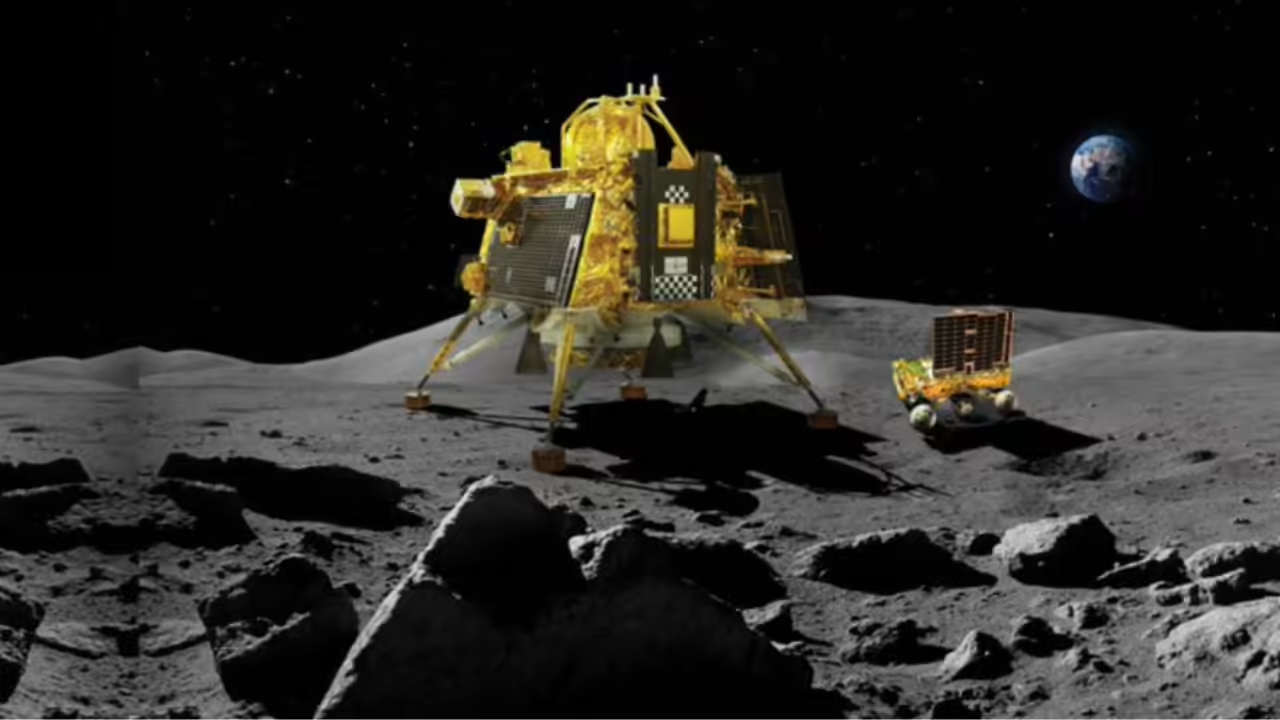
India’s space programme offers the clearest demonstration of this philosophy. Over the years, it has built an ecosystem that emphasises incremental learning, reuse of proven technologies, and relentless systems integration. The successful soft landing of Chandrayaan-3 near the Moon’s south pole was not merely a symbolic victory. It represented mastery over some of the most difficult aspects of spaceflight: autonomous navigation, real-time hazard detection, propulsion throttling, and precision control in an unforgiving environment. These are technologies that even well-funded programmes have struggled to perfect. Similarly, the insertion of Aditya-L1 into a halo orbit around the Sun–Earth L1 point showcased India’s growing competence in deep-space navigation and long-duration mission planning. This was not an extension of low-Earth orbit operations; it was a fundamentally different class of challenge requiring advanced modelling, continuous course correction, and sustained operational discipline. Earlier, the Mars Orbiter Mission had already demonstrated India’s ability to execute complex interplanetary missions on the first attempt which something few countries have managed. What stood out was not just the cost, but the reliability of execution. All these achievements are cumulative that implies India’s space successes are not isolated miracles rather the outcome of decades of compounding competence.
If space represents India’s scientific ambition, defence represents its strategic autonomy. As India’s low aggregate R&D intensity has not prevented high-end capability building. The BrahMos missile is among the most visible examples of India’s defence-technology stature. It is one of the world’s fastest operational cruise missiles. Further, India’s anti-satellite capability in 2019 demonstrated precision interception whereas the MIRV-enabled Agni-5 test in 2024 showed high-level systems integration. These indigenous advances have reduced reliance on foreign suppliers in some of the most sensitive areas of defence technology. These are not incremental upgrades but they are foundational capabilities that redefine strategic autonomy.
The Quiet Paradox of Underutilisation
And yet, even as India demonstrates extraordinary effectiveness in these mission-mode programmes, another reality persists: R&D funds are not always fully utilised, even when allocated. Official data shows gaps between budgetary allocation and actual expenditure under several major science and technology schemes. This underutilisation does not stem from lack of ideas or ambition. Instead, it reflects administrative friction and limited absorptive capacity in parts of the civilian research ecosystem. The paradox is striking. On one hand, India extracts world-class results from constrained budgets in strategic sectors. On the other, it struggles to fully deploy even the modest funds it allocates to broader scientific research. This contrast highlights a deeper truth: India’s innovation challenge is not just about money but it is also about institutions.
Perhaps the most important lesson from India’s R&D journey is what it reveals about the country’s human capital. The engineers, scientists and technicians who deliver these breakthroughs are not fundamentally different from their peers elsewhere. What is different is the context in which they operate. Additionally, India has no shortage of talent. What it has is a shortage of opportunity structures that consistently convert talent into discovery. As a result, large parts of India’s scientific and technical talent remain underutilised.
Imagining the Inflection Point
The most compelling question: what happens when India decides to scale its R&D effort seriously? If India can achieve lunar landings, interplanetary missions and advanced strategic systems with GERD below 1% of GDP, what becomes possible when that figure rises to 1.5% or 2% with stronger private-sector participation? The answer is not incremental improvement; it is transformation. As increased R&D investment would unlock dormant capacity. It would allow India to move from isolated excellence to system-wide innovation.
India’s achievements in space and defence are the natural outcome of a society that has learned to innovate under constraint over decades. The label jugâdu shows that India is not just making do with less but it is doing more with intent. History shows that nations rise when latent capability meets sustained investment. India’s record proves that the capability is already there. The effectiveness and efficiency demonstrated with limited funds are a baseline. So, the day India decisively increases its R&D expenditure will be the day it moves decisively ahead of its peers. When that happens, the world will no longer speak of Indian innovation as an anomaly.
Annu Kumari: Assistant Professor, Sri Aurobindo College (Evening), University of Delhi