It is, in the final analysis, the living breath of India’s ancient modern Constitution—a document that was not borrowed, but built; not copied, but composed; not imposed, but inherited and continuously recreated. — Deepak Sharma
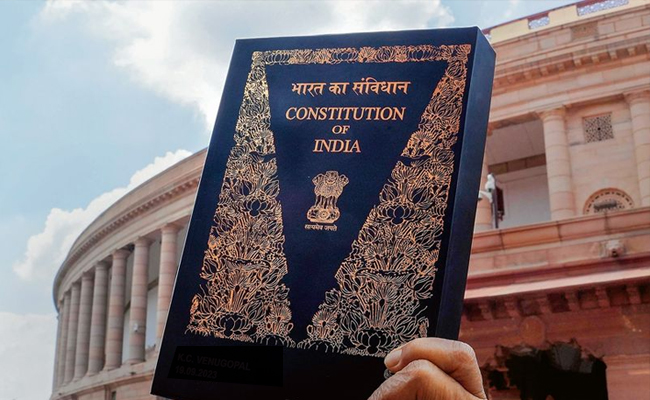
Seventy-five years after its adoption, the Indian Constitution remains one of the most remarkable political experiments in human history. It is not merely a legal document but a social contract, a moral compass, and a testament to the civilisational depth of a subcontinent that has long grappled with the question of how to govern diversity justly. Yet, in popular discourse—both within India and abroad—the Constitution is often reduced to a derivative artefact: a well crafted collage of the Government of India Act 1935, the Irish Directive Principles, the Canadian federal model, and the American Bill of Rights. This narrative of “borrowing” obscures a deeper truth. India’s constitutional imagination did not begin in 1946 with the arrival of the Cabinet Mission, nor did it end in 1950 with the signing of the calligraphed parchment. It is a living inheritance, a conversation between epochs—Vedic, classical, medieval, colonial, and postcolonial—that continues to unfold.
To understand the Constitution as an indigenous flowering rather than a colonial imposition, one must first journey to the sabha and samiti of the Rigvedic era. These were no mere tribal councils; they were deliberative bodies where warriors (kshatriyas) and priests (brahmanas) debated matters of war, peace, and resource allocation. The sabha functioned as a kind of upper house, often restricted to elders and elites, while the samiti was a more general assembly. Decision making was not autocratic; it required consensus or, failing that, a form of majority opinion. This was not democracy in the modern sense—suffrage was limited, and caste hierarchies were present—but the principle that rulership required collective validation was firmly established. The Atharvaveda goes further, prescribing that the samiti should be united in thought and purpose, an early articulation of what we might now call social solidarity.
If you want to see the Constitution as a flowering of a colonial imposition you have to go back, to the sabha and the samiti of the Rigvedic era. The sabha and the samiti were not councils. The sabha and the samiti were discussion groups where warriors (kshatriyas) and priests (brahmanas) talked about war, peace and how to share resources. The sabha acted like a house. Only allowed elders and elites. The samiti acted like an assembly. Welcomed a broader crowd. Decision making did not follow a ruler. Decision making required agreement. If agreement failed decision making required a form of majority opinion. The system did not operate as democracy in the sense—voting rights were limited and caste system was present—. The principle that rule required group approval was firmly established. The Atharvaveda goes further prescribing that the samiti should be united in thought and purpose, a description of what can be called solidarity. Thousands of years later the instinct found its advanced form, in the gana sanghas—the republican states that grew along the Himalayan foothills and, in the Gangetic plains. The Licchavis of Vaishali are a known example. The Licchavis of Vaishali had a governing council of 7,707 members each member representing a kula (clan). The governing council voted on decisions and the salakha griha (ballot hall) was used for voting. The gana sanghas kept a treasury collected taxes and even handled policy through group discussion. The gana sanghas could do all that together. When the Buddha visited Vaishali the Buddha admired the ways. The Buddha took some of those ways into the community. Alexander’s Greek historians, writing in the century BCE expressed surprise at finding “cities” in the Indus Valley.
Even the Manusmriti, so often invoked as a symbol of Brahmanical orthodoxy and social rigidity, contains within its verses a vision of rule bound governance that bears a distant kinship with constitutionalism. Manu’s emphasis on rajadharma—the duties of the king—was not a licence for absolutism. The king was subordinate to dharma, a transcendent law that even he could not violate. He was enjoined to consult with ministers, respect customary laws, and ensure that the varnas performed their mutual obligations. While the Manusmriti is unquestionably hierarchical and excludes vast sections of the population from political participation, its insistence that sovereignty is conditional—that power must be exercised within a framework of duty and restraint—prefigures the modern idea of a limited government. The Constitution of 1950 replaces dharma with fundamental rights and directive principles, but the underlying logic is analogous: no ruler, not even a democratically elected parliament, is above the law.
These ancient and classical institutions did not survive the centuries intact. The rise of imperial formations—the Mauryas, Guptas, Delhi Sultanate, and Mughal Empire—concentrated power in monarchies that were often autocratic. Yet the republican spirit did not vanish; it retreated to the margins, finding refuge in village panchayats, caste councils, and mercantile guilds. When the British arrived, they encountered a subcontinent teeming with self regulating local bodies that collected taxes, adjudicated disputes, and maintained irrigation systems. The colonial state, distrustful of these autonomous nodes, systematically dismantled or co opted them. But the memory of self rule persisted, surfacing in the nationalist movement and ultimately shaping the constitutional debates of the 1940s.
It is in this context that the work of the Constituent Assembly must be understood. The 299 members who gathered in the Constitution Hall did not approach their task as blank slates, nor as mere copyists. They were inheritors of multiple traditions—Western liberalism, socialist thought, Gandhian philosophy, and indigenous republicanism—and they synthesised these strands with remarkable ingenuity. When B.R. Ambedkar, the chairman of the Drafting Committee, defended the Constitution in his final speech on 25 November 1949, he did not deny that it contained “good parts taken from other constitutions.” But he insisted that these borrowings were adapted to Indian conditions. More importantly, he anchored the document in the “life of the people,” acknowledging that constitutional morality could not be enforced by law alone; it required a society committed to liberty, equality, and fraternity.
The charge of “borrowing” thus misses the forest for the trees. Structural similarities—a parliamentary system, a federal scheme, a judicial review mechanism—do not negate the distinctive Indianness of the Constitution. Consider federalism. India’s version is not a compact of pre existing sovereign states, as in the United States, nor a devolution of power from a unitary centre, as in the United Kingdom. It is a novel creation: a union of states that is indestructible, yet deeply respectful of linguistic and cultural diversity. The reorganisation of states along linguistic lines in 1956 was not a concession to parochialism; it was a recognition that India’s pluralism could not be flattened into a monolithic national identity. This sensibility—that unity and diversity are not opposites but complements—has ancient roots in the subcontinent’s civilisational ethos, which has always valued the whole (samagra) without erasing the particular.
The Fundamental Rights chapter, too, while drawing upon the Universal Declaration of Human Rights, is infused with an indigenous conception of duty. Article 21 guarantees the right to life and personal liberty, but the Supreme Court has expansively interpreted this to include the right to livelihood, health, and a clean environment. This holistic understanding of rights—as inseparable from the material conditions of existence—resonates with the ancient ideal of dharma, which never separated individual well being from collective welfare. Similarly, the Directive Principles of State Policy echo rajadharma: the obligation of the state to secure a just social order, to minimise inequalities, and to ensure that the operation of the economic system does not result in the concentration of wealth. These principles are not enforceable in court, but they are fundamental to the governance of the country. They represent a constitutional commitment to substantive justice, not merely formal legality.
The resilience of this constitutional order has been tested repeatedly. The most profound test came in 1973, when the Supreme Court delivered its judgment in Kesavananda Bharati v. State of Kerala. The case arose from a land reform dispute, but it escalated into a fundamental question: could Parliament amend any part of the Constitution, including Fundamental Rights? The Court, by a narrow majority, held that Parliament could not alter the “basic structure” of the Constitution. This doctrine—now a cornerstone of Indian constitutional law—was not explicitly mentioned in the text; it was an act of judicial interpretation that drew upon the implicit architecture of the document. The Court did not invent the doctrine out of thin air; it discerned a logic that was already present: that certain features—secularism, federalism, judicial review, the rule of law—are so integral to the constitutional identity that they cannot be destroyed even by a supermajority in Parliament. This was not a Western import; it was an Indian innovation, born of the specific anxieties of a postcolonial polity struggling to reconcile democratic majoritarianism with constitutional fidelity.
Two years later, the Emergency of 1975 77 provided an even starker test. Indira Gandhi’s government suspended Fundamental Rights, imprisoned political opponents, and muzzled the press. The Constitution, in a formal sense, was not abrogated, but its spirit was suffocated. Yet the very fact that the Emergency was imposed through constitutional amendments—and that it ultimately collapsed under the weight of public resistance—demonstrates the deep internalisation of constitutional norms among Indians. It was not the courts alone that defended the Constitution; it was students in Delhi who pasted copies of the Fundamental Rights chapter on walls, journalists who defied censorship, and ordinary citizens who voted against the regime in the 1977 election. The Constitution, in that moment, ceased to be a lawyer’s document and became a people’s charter.
Today, the Constitution faces a different kind of threat. It is not a coup or an explicit dictatorship that endangers it, but a slow erosion of the very idea of the political. The forces of globalisation, market fundamentalism, and consumerism threaten to reconfigure the citizen as a mere consumer and the nation as a mere market. This is an economic war, but it is also a constitutional war. When multinational corporations use intellectual property regimes to appropriate traditional knowledge, when volatile capital flows destabilise local economies, and when cultural homogenisation erodes linguistic diversity, the constitutional promise of economic justice and cultural rights is undermined. The state, which is constitutionally obligated to secure a just social order, finds its sovereignty constrained by international trade agreements and credit rating agencies.
It is in this context that the government’s call for Swadeshi—for making and buying Indian—must be understood. Critics often dismiss this as economic nationalism or populist rhetoric, but it has a deeper constitutional significance. The original Swadeshi movement of the early 20th century was not merely a boycott of British cloth; it was a comprehensive programme of self reliance that sought to rebuild India’s economic fabric from the village upwards. It was rooted in the belief that political freedom was incomplete without economic freedom. The Constitution, in its Directive Principles, enshrined this ideal. Article 38 mandates the state to minimise inequalities in income and eliminate inequalities in status, facilities, and opportunities. Article 39 directs the state to ensure that the ownership and control of material resources are distributed to best serve the common good, and that the operation of the economic system does not result in the concentration of wealth. These provisions are not socialist slogans; they are constitutional commands.
Yet, for decades, India pursued an indecisive development model—neither genuinely socialist nor consistently market oriented. The result was what the economist Raj Krishna famously called the “Hindu rate of growth”: a sluggish expansion that failed to generate sufficient employment or lift the mass of the population out of poverty. The liberalisation of 1991 accelerated growth but also deepened inequalities. The demographic dividend—India’s youthful population—has become a demographic liability in the absence of adequate jobs. Every year, millions enter the workforce, but only a fraction find formal employment. The rest are pushed into the informal sector, underemployment, or despair.
The Constitution, as a living instrument, must respond to this crisis. The response cannot be merely legislative or judicial; it must be cultural. The Swadeshi mindset, reimagined for the 21st century, offers a framework. It does not mean autarky or xenophobia; it means fostering an ecosystem where Indian entrepreneurs—whether they manufacture smartphones, design fashion, or develop software—can thrive. It means shifting the educational paradigm from rote memorisation to problem solving, from exam oriented coaching to critical thinking. It means teaching financial literacy alongside algebra, and destigmatising manual trades and small scale enterprises. It means viewing every young person not as a job seeker clamouring for government employment, but as a potential job provider, a wealth creator, an innovator.
Government initiatives such as Startup India, the Mudra scheme, and the National Education Policy 2020 are steps in this direction, but they remain fragmented and inadequately implemented. What is required is a mass movement, akin to the freedom struggle, that mobilises citizens—especially the youth—around the ideal of self reliant India (Atmanirbhar Bharat). This is not a statist project; it is a societal one. It requires the active participation of universities, corporations, cooperatives, and local communities. It requires a shift in consciousness: from viewing the Constitution as a document that guarantees rights to viewing it as one that imposes duties—duties to oneself, to one’s community, and to the nation.
The Swadeshi call is thus both an economic imperative and a constitutional one. It is the contemporary articulation of rajadharma—the duty of the state and the citizen to secure the welfare of all. It is also a reaffirmation of the ancient republican spirit: the belief that a polity is not a passive entity to be governed, but an active community that governs itself. The Constitution provides the framework; the people must provide the energy.
As India enters its 78th year of independence, the question is not whether the Constitution will survive—it has already proven its resilience—but whether it will thrive. Survival is mere continuity; thriving requires renewal. The Constitution must be constantly interpreted, debated, and applied to new circumstances. It must be defended not only in courtrooms but also in classrooms, not only in Parliament but also in panchayats, not only by judges and politicians but also by entrepreneurs, artists, and ordinary citizens.
The narrative that the Indian Constitution is a borrowed document is not merely inaccurate; it is impoverishing. It denies the depth of India’s democratic heritage and obscures the creativity of its constitutional founders. It also discourages the current generation from investing emotionally and intellectually in the document. A borrowed garment is worn until it wears out; an inherited one is cherished, mended, and passed on. The Indian Constitution is an inheritance—not from the British, but from the Vedic seers who envisioned the samiti, from the Licchavi councillors who voted in Vaishali, from the panch elders who adjudicated disputes under banyan trees, from the nationalist martyrs who gave their lives for swaraj, and from the Constituent Assembly members who debated late into the night.
To honour this inheritance, the current generation must translate the Constitution’s lofty ideals into tangible realities. Justice must mean not merely access to courts but access to livelihoods. Liberty must mean not merely freedom from coercion but freedom from hunger. Equality must mean not merely non discrimination but a fair distribution of opportunities. Fraternity must mean not merely tolerance but active solidarity across lines of caste, creed, and region.
The Swadeshi movement, reimagined for the 21st century, is the vehicle for this translation. It is the means by which the constitutional vision of a just, free, and equal society can be realised. It is the thread that connects the sabha of the Rigveda to the Startup India scheme, the gana sangha of Vaishali to the self help group in rural Bihar, the rajadharma of Manu to the Directive Principles of Part IV. It is, in the final analysis, the living breath of India’s ancient modern Constitution—a document that was not borrowed, but built; not copied, but composed; not imposed, but inherited and continuously recreated.