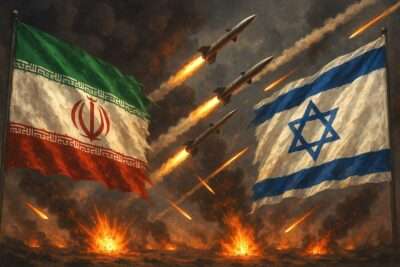
The wars are destabilising the world. The United Nations was formed on the perils of League of Nations. There is a strong need of a powerful World Organisation without any veto power or domination of powerful countries. — Vinod Johri
When On February 28, 2026, the United States and Israel launched coordinated, major airstrikes against Iran, targeting nuclear, missile, and military infrastructure to force regime collapse, nobody had a clue when the war will end. The US’s imperialism and expansionism and Iran’s leadership of Islamic world based on religious fanaticism and its ambitions of ruling the world with sword, clashed. This war was imminent on geopolitical factors and war-fear was looming large for quite some time. The attacks, named “Operation Epic Fury,” included a strike in Tehran that killed Supreme Leader Ayatollah Ali Khamenei. Iran retaliated by attacking US and Israeli personnel and allies across the region, including the UAE. The strikes specifically aimed at Iranian leadership, with the death of Ayatollah Khamenei, leading to the appointment of his son, Mojtaba Khamenei, as successor. Iran fired missiles and drones at Israel, US bases, and regional neighbours, including Saudi Arabia, Bahrain, and the UAE, causing disruptions to air travel and infrastructure. The operation aimed at “instant capitulation” of the Iranian establishment.
Now the whole world is slowing plunging into oil and gas crisis. There appears no possibility of mediation except when the US and Iran realise,they are bringing their ruination too close. Initially, Donal Trump anticipated the end of his operation in a week but it goes beyond his control. When Russia launched a full-scale invasion of Ukraine on February 24, 2022, marking a massive escalation in the Russo-Ukrainian War, it was also supposed to end is week but the end looks too far.
Since 1946 since the UNO was established, there have been over 285 distinct armed conflicts globally, with roughly 30 to 50 active, smaller-scale conflicts occurring each year, making the post-WW-II era highly volatile. A record 56 active conflicts were reported in 2024, involving 92 countries.
It is imperative to go into flashback of World War-II.
Liberal Global Order
On October 30, 1943, the representatives from the UK, the US, China and the USSR met in Moscow and signed a declaration which recognised the necessity of establishing an international organisation, based on the principle of the sovereign equality of all peace-loving states and open to the membership by all such states, large and small, for the maintenance of international peace and security. The Tehran Conference, held from November 28 to December 1, 1943, was the first meeting of the “Big Three” Allied leaders: Franklin D. Roosevelt (USA), Winston Churchill (UK), and Joseph Stalin (USSR). The Tehran Declaration was issued on December 1, 1943, pledging to work together in war and post-war peace to banish the scourge of war for many generations and make a peace which will command the goodwill of the overwhelming mass of the peoples of the world. They coordinated final military strategies against Germany, including Operation Overlord(6 June-30 August 1944), the massive Allied invasion aiming to liberate Western Europe from Nazi control during WWII, and pledged to create an enduring post-war peace.1
The League of Nations had turned largely inactive and defunct during World War II. The stage was set for the creation of the successor institution of the League of Nations which formally ended on April 19, 1946. Following a final assembly in Geneva, the organization voted to dissolve itself, transferring its assets and mandate to the newly established United Nations (UN).
From April 25 to 26 June 26, 1945, the delegates from 50 nations, representing almost eighty percent of the humanity, met in San Francisco and founded the United Nations Organisation (UNO).2
UN Moving From Global Multilateralism to Guided Multilateralism
‘We, the people of the United Nations, determined to save succeeding generations from the scourge of war, which twice in our lifetime has brought untold sorrow to mankind….’
Those were opening words of the preamble to the United Nations Charter, which was signed on 26th October 1945, by the representatives of fifty nations, who had gathered in the Veterans’ War Memorial building in San Francisco. Not all 50 nations that came forward on that day were independent. Some of them including Bharat were still under colonial rule. But the two world wars that killed almost 40 million people in just 30 years had shaken their conscience.
The two leaders who were architects of the multilateral body, Franklin Roosevelt of the US and Winston Churchill of the Great Britain, were both unavailable for this historic event. While Roosevelt passed away earlier in the year, Churchill, British war hero was rejected by the people in the British Parliamentary elections held in July 1945. Harry Truman, the US President was there for the inauguration and gave scintillating speech, ‘There were many who doubted the agreement could ever be reached by these 50 countries differing so much in race and religion in language and culture. But these differences were all forgotten in one unshakable unity of determination to find a way to end wars’.
The United Nations demonstrated highly idealistic objectives: fundamental human rights, the dignity and worth of the human person, the equality of men and women, the equal treatment and sovereign equality of all nations, the strengthening of international peace and security, the building of the international institutions to improve the living standards of the people of all nations and regions. Many such laudable goals guided the multilateral organisation aiming to build a liberal world order for the entire humanity.
The founding of the United Nations, with all its allied organisations, like the World Bank, the International Monetary Fund and the International Court of Justice (ICJ) in the immediate aftermath of the Second World War was just as significant for the creation of the New World Order. The US took the lead in this great initiative to govern global security & the monetary policy.3
Unfortunately, the UN faced multiple challenges since its inception. Even at the initial stage, there were discords over the structure of the UN Charter itself, which centred on the insistence of the so called Big Five countries - the United States, the USSR, the United Kingdom, France and later China, demanding veto power in the decision-making deliberations of the United Nations Security Council. Many countries asserted that this right of veto should be eliminated or curtailed to a minimum. However, the five nations, which described themselves as permanent members of the Security Council, took a grandstanding position, arguing that the responsibility for maintaining peace in the world would rest primarily on their shoulders. Therefore, they needed the veto regime. At the very outset, instead of ‘global multilateralism’ what emerged was ‘guided Multilateralism’.
More and more voices were raised over the growing ineffectiveness and inefficiency of the UN. ‘It has been said that United Nations was not created in order to bring us to the heaven but in order to save us from the hell’, said Dag Hammarskjold, the Swedish diplomat who served as the second Secretary-General of the UN from 1953 to 1961.
Sadly, in the face of growing geopolitical tensions, wars and competing national self-interests, the UN has been struggling to keep up this role. The big powers routinely ignored or bypassed the UN and decided to act unilaterally or in the collaboration with the other powers.
The tragic reality of the past seven decades of the UN Security Council’s existence is that the greatest threat to the global security has not stemmed from the external sources but from the unilateral actions of the Council’s five security members states.
More and more voices were raised over the growing ineffectiveness and inefficiency of the UN. ‘It has been said that United Nations was not created in order to bring us to the heaven but in order to save us from the hell’, said Dag Hammarskjold, the Swedish diplomat who served as the second Secretary-General of the UN from 1953 to 1961.
Sadly, in the face of growing geopolitical tensions, wars and competing national self-interests, the UN has been struggling to keep up this role. The big powers routinely ignored or bypassed the UN and decided to act unilaterally or in the collaboration with the other powers.
The tragic reality of the past seven decades of the UN Security Council’s existence is that the greatest threat to the global security has not stemmed from the external sources but from the unilateral actions of the Council’s five security members states.4
Bharat Suffered Too: UN Failed on Kashmir
The division of the world into two power blocks and the global clash in the interests and ideologies represented by them, had made a realistic and firm approach to any question purely on the merit of the case by the UNO or any other agency created by it well-nigh impossible. These power blocks looked at every situation from the angle of their own advantage in the Cold War that had been raging furiously between them for a long time.
The interest of the Anglo-US bloc which dominated the United Nations Commission on India and Pakistan because of its secured domination over the UNO, in Kashmir was well known. The Anglo-Americans worked for the partition of the undivided Bharat because of their fear that independent Bharat might follow an independent, and may be, anti-imperialistic foreign policy. They looked upon Pakistan as a pet and dependable horse in their struggle.5
Referring to the conduct of the United Nations on the question of Kashmir, Shri Madhav Sadashivrao Golwalkar, Guruji, former Sarsanghchalak of Rashtriya Swayamsevak Sangh said, ‘Might is today the only basis of the behaviour of nations towards another. The United Nations talks tall of the high principles. But what is the stark reality? The reality is that it is backing the interests of the powerful and imperialistic nations. To these countries, the state we created by our uniquely, perverse ability is dearer than the country. And they love it for no better or higher reason, than that they can get from it, military bases, air bases and of course abundant cannon folder.’6
The US and British intervention in the UN on Kashmir issue and their overt and covert support to Pakistan in invasion on Kashmir post-independence cost Bharat with cessation of more than half of Kashmir to illegal occupation of Pakistan and China.
The wars are destabilising the world. The United Nations was formed on the perils of League of Nations. There is a strong need of a powerful World Organisation without any veto power or domination of powerful countries. The splinters like G-7, G-20, EU, SAARC, BRICKS…. have not brought peace to the world. Bharat is in a position to lead the world with VasudhaivKutumbakam ideals. The hegemony of the superpowers and Islamic fundamentalism has to be brought to end, so that 8.3 billion people on the earth may live in peace and harmony.
References:
- United Nations website: https://www.un.org
- The New World – 21st Century Global Order and India by Ram Madhav –Rupa Publications, New Delhi, 2025, pp. xxxi-xxxii
- The New World – 21st Century Global Order and India, Ram Madhav, Rupa Publications, New Delhi, 2025, pp. xxxi-xxxii
- The New World – 21st Century Global Order and India, Ram Madhav, Rupa Publications, New Delhi, 2025, p. 119
- Organiser, 04.01.1950, Front Page
- Organiser – 16 April 1951 – Front Page and page-2 - Guruji Shri Madhav Sadashivrao Golwalkar on Kashmir – UNO Bungling – The Task for Today